Thursday, March 23, 2017

Bridging: a new venture and a new blog

Like all who consider themselves progressives, I have spent the last few months trying to figure out what to do in a Trump-led nation. The election itself totally did not surprise me: I see it is one moment in a long-running conflict between those who want to open society to diverse experiences and values, and those who want to close down, withdrawing to familiar and harmonious walled communities. This conflict is a central theme of my book Trust in a Complex World. I expect it to go on for a long time, a century or more; and if we don’t destroy ourselves along the way (which is quite possible), I expect that the liberation of human capacities represented by the Opening, or progressive, tendency will win out.
But that doesn’t answer what to do at this critical moment. What I have come round to now is The Bridging Project.
There are, I think, three essential things that progressives need to do now: fighting, helping, and bridging. Fighting is trying to win specific elections and court battles to fend off the reaction. Helping is providing support for those hurt by the current policies – including immigrants, those who lose health care, victims of environmental degradation. Those two areas have already generated considerable action.
The third activity, bridging, involves reaching out to Trump supporters: trying to understand the roots of their disaffection with the establishment and progressivism, and to build with them a vision of a future that can include us all. It's hard -- hard personally to listen to and seek to understand views that we find abhorrent; and hard in practice to find venues for the kind of open conversation that’s needed.
Yet I think bridging, which is so far the most neglected of the three activities, is vital in both the short and long run. In the short run it may open ways to undermine the Trump base and thus diminish his impact. In the long run it is the only true exemplification of our highest values. We value inclusion, globalization, diversity; we cannot win by excluding nearly half the country who feel lost, undermined, humiliated by those same developments. We have to build a future with them. That may be hard to imagine, but it’s the only way human history has progressed in the past, and the only way progressives can genuinely win in the future.
So I will be looking for ways to advance a Bridging agenda. It’s not opposed to fighting, of course. It’s not about compromise or backing off core values. But it is about seeking understanding, even of those who have very different views from myself – understanding where they come from, and trying to imagine where we all together can go to.

For this purpose I have started a new blog: “Coming to understanding”. It will focus on practical efforts to develop bridging conversations,

Tuesday, February 14, 2017

We have to stop using the R-word: racism as a shared problem

One thing emerging from the heated start of the Trump presidency is that accusations of racism are emotional triggers: they trigger liberal pride and unity, and conversely intense conservative rage. A friend of mine, for instance, has been interviewing Trump supporters, and he consistently gets responses like this:
Q: “What do people think about your politics that just isn't true?”
A: “Where to start?  That I am some sort of evil, terrible, racist, sexist, bigoted, homophobe.  I am not any of those things.”
Arlie Hochschild’s book, Strangers in Their Own Land – which should be required reading for all liberals – highlights the same theme: at one point she comes to the realization that Rush Limbaugh serves as “a firewall against liberal insults”. She quotes a Limbaugh fan:
“Liberals believe that Bible-believing Southerners are ignorant, backward, rednecks, losers. They think we're racist, sexist, homophobic, and maybe fat.” (p. 22)
If the world were really polarized into racists and non-racists, it might be a good thing to unite the latter against the former. But it’s not: racism, like other -isms, is a complex phenomenon, not an inborn personality disorder. People learn to overcome racism, a journey that is long and arduous. Most conservatives have moved a long way in in that journey in the last half-century. Moreover, most liberals still have a long way to go.
We shouldn’t be polarizing this; we should be working together on it.
Most conservatives in Hochschild’s account of the Louisiana heartland, and many others, have entirely accepted the idea that Blacks should be treated equally, that they are not inferior, that they can be good neighbors. They often interact freely across racial lines at work, and probably as much as Northerners in churches and neighborhoods. They would not resist a Black family moving into the area, or Black or Hispanic children attending class with their children. And we should recognize that these are enormous and hard-won advances. One Louisianian recalls how he used the “N-word” freely in his childhood, like everyone else – and then abruptly recognized the hurt it caused and stopped using it. It was well within my memory that Governor George Wallace stood in the doorway of the University of Alabama proclaiming “segregation forever”. We don’t see anything remotely like that now; those attitudes have changed profoundly. It’s an amazing human achievement.
And how about ourselves, liberals of the coasts? Our neighborhoods, in my hometown of Princeton and my old hometowns of Boston and New York, are profoundly segregated. Our elementary schools in practice often reflect that separation. High schools have formally integrated, but then largely tracked races and ethnicities into different classrooms. Blacks continue to lag in income, health, and almost every other measure of well-being. Profound mistrust continues between police forces and minority communities.
In other words, we haven’t solved the problem of inclusion. We should be a little more humble about it. We have a lot of work to do, in the North as in the South and everywhere. Inclusivity is a process, and a hard one, demanding deep change in identities and ways of life, often triggering fear and anger. As a matter of fact, my sense is that in parts of the South Whites interact with Blacks more comfortably and frequently, and with more genuine equality, than in the liberal bastion of Boston. But of course no section of the country has reached the desired end point.
But now accusations of racism have become the flashpoint for really dangerous polarization, which is rapidly hardening into a divide that will be hard to overcome. And it’s unnecessary. Very few people are deliberately racist; pretty much everyone is racist in some respects; but liberals have claimed the moral sword and are using it against conservatives. And by setting up this battle, we make things worse: we lose the opportunity to find allies on many issues, to undercut the Trump coalition, by using the R-word as a battle standard.

It’s time for a reframing. We all have work to do.  And, by the way, racism is only part of  that work. The broader issue of diversity – the changing roles and status of immigrants, Hispanics, Asians, women, gays – is very much a continuing and unresolved challenge. The economic inequality that has torn apart the lives of factory workers in Michigan and oil workers in Louisiana – that’s something we are all part of as well, and all need to work on. These are not problems where one side of the political spectrum has all the moral right and the other has all the wrong; these will be hard to solve, and that we all need to play a part in the building the solution. As long as we keep hurling insults – and I’m looking at my own liberal tribe here – we will make it impossible to actually make progress on any of them.

Thursday, February 9, 2017

The vicious circle of mistrust - and liberals' part in it

We of the left are still tending to delude ourselves in assuming that Trump supporters will come around to our point of view. We couldn’t believe that people would vote for someone as awful as Trump, and we were wrong. Now we assume that people will soon wake up to his awfulness and reject him. But it’s far from that simple. The root of the problem goes far deeper than lack of information or errors in calculating self-interest. Trump emerges from a collapse of trust – and that is not easy to reverse.
I know something about trust. I’ve written a book about it (Trust in a Complex World). And one thing I know is this: if you think trust and harmony will restored by others finally seeing that you are right, you will be sadly disappointed.
We of the Left look and Trump and see someone who constantly violates our deepest values, and assume therefore that anyone who supports him must be evil. Those of us who are comfortable in the current system – well-educated, benefiting from globalization, loving the growing diversity of music and food and culture around us – see him as a destroyer of the good. Those who consider ourselves expert on some part of the system – economics, or international affairs, say – see him taking reckless actions  that may blow everything up, and we assume everyone else will eventually see the danger.
But here’s what Trump’s supporters see: they see a world that for decades has undermined their communities, criticized their moral codes, weakened their status; they see a future that will increasingly marginalize their way of life; they see a leadership elite that is utterly alien to their sense of what’s right – a bunch of people on the coasts who love things that they hate and hate things that they love, who do not respect them, who treat them as idiots and boobs. And in Trump they see a guy who promises to break that elite, who delights in mocking them and enraging the pundits and the experts and the educated. Whether or not they agree with specific policies, Trumpists see a validation of their way of life for the first time in generations. And the more we object and protest, the more they feel Trump must be on the right track. For them, the fact that Trump is violating rules left and right is not a failing, it’s a virtue.
So what we have is a vicious circle of mistrust, one of the most dangerous of human phenomena. It has led throughout history to wars and mass destruction. When views get polarized in this way, the worse things get the more dug in the sides become. Opposition fuels a self-fulfilling prophecy. Things can literally never get bad enough that people stop and say, “Oh, we were wrong” – because they can always  blame failure on the opposition’s resistance.
We are in danger of that terrible dynamic. We of the Left talk a lot about inclusiveness, but we have done a very poor job of including much of the country. Now we’re finding ourselves forced into the position of claiming that half the citizenry is deluded or evil or stupid. That should make us uncomfortable – indeed, it should be completely unacceptable to us. But we are falling into the old pattern of saying if only those who disagree with us didn’t disagree with us, everything would be all right.
The vicious circle of mistrust won’t fix itself. It won’t end because our opponents see the light. It won’t end because our moral view of the world triumphs. It will not end with the victory of one side. It will end when the vast majority of the country – not 51%, but 75% or more – build together a sense of the future that they can all live with and live in. The only way to stop the spiral towards mutual destruction is to connect, to forge new relations of inclusion and understanding, across the lines. And the place we can start, those of use on the Left, is by understanding better where the Trumpists are coming from, rather hurling insults at them.

Friday, February 3, 2017

This is what a revolution feels like - from the wrong side

This post was written just after the election, then appeared as an op-ed in the New Jersey Star-Ledger.
================
What Trump's populist supporters want is a revolution.
They feel left out of the big social and economic trends of the last 40 years: globalization, knowledge work, diversity. They feel deeply alienated from the coastal elites, who thrive in this new environment, who flaunt not only their wealth but also their tastes and moral codes - internationalism, foreign foods ("cheese-eating"), open homosexuality. The more those elites gain, the more marginalized the rest of the country feels.
These revolutionaries have lost faith in the system. In the 1950s, those in small towns already felt alienated from the Eastern intellectuals and experts, but also proud of the progress of science and the economy, and confident that the benefits would flow to all. Now large numbers of people, especially away from the coasts, have lost that confidence. "Progress" continues, "experts" keep inventing things, but all that they experience is that their lives are disrupted and their status diminished. And they want it to stop.
They see Trump as someone who will break the system.
It really doesn't matter what he says; what matters is that he doesn't care what the elites think. The experts say that globalization brings economic good; Trump tells his supporters it doesn't. The experts say that things are getting better; Trump tells them things are getting worse. What Trump tells them is much closer to their experience than what the experts say.
I am part of the meritocratic elite, the aristocracy of the current period -- the educated class that has profited nicely from globalization and the knowledge economy. Of course I don't feel like an aristocrat: I'm not at all (think I) like those foppish prigs on "Masterpiece," who ride their horses over peasants in their path. I work for human rights and social justice; I vote for those who would increase my taxes in order to strengthen social programs for the poor.
And yet in the important ways I, and my meritocratic friends, are indeed like all aristocrats. We have high status and self-confidence, while the revolutionaries have been losing all that for decades. And if truth be told, we harbor scorn for a large part of the country who, as Obama once put it, "cling to guns or religion"; or whom Hillary Clinton lumped into a "basket of deplorables."
I hear constantly my colleagues marveling at the stupidity, the ignorance of Trump's supporters, or dismissing them as racist and so not worth talking to. Some of us are kinder than others to the downtrodden, but the revolutionaries make no distinctions among us.
We aristocrats are naturally horrified by Trump. We know from our expertise and rational analyses that his policy proposals are destructive, and we feel disgusted by his crudeness and hostility. But that is what elites have always felt in the face of revolution. The French aristocracy were offended by the vulgarity of the uneducated mob; so has every aristocracy at every historical turn. The Eastern establishment felt pretty much as horrified by the radicals of the 1960s, with their long hair and loud music, as they do about Trumpists today. Revolutionaries are deliberately ugly and hostile and crude. Their leaders always relish sticking fingers in the eyes of established leaders, and revel in provoking outrage.
In this election Clinton represented the continuation of what has been going on for the last 50 years -- a perfect embodiment of the current establishment, everything that the revolutionaries reject. She is a wonkish expert, has been in government forever, deeply connected to international financial moguls; she made promises for improvement, but they are the same promises that everyone has made over all that time. Even her gender represented a culmination of the long elite push for moral change in roles.
I myself voted for Clinton with considerable enthusiasm. I believe deeply in the ethic of diversity and progress that she represents. But I also think she did not understand the revolution, and its roots.
The revolutionaries were not calculating their material self-interest, and are not interested in incremental improvement. The current system makes them feel lost and overwhelmed and excluded, and they voted to break it.
Revolutions fail most of the time: they become repressive or chaotic, and often turn on their own supporters. The exceptions are rare. Once in a long while a true revolutionary, someone who has led the charge against the elites - Nelson Mandela, for instance - turns out to be a transformative leader. Once in a long while, leaders emerging from the elites, like FDR, seemingly safe protectors of the existing order, break the system themselves and reconstruct it. Much more often, however, revolutionaries turn out to be more like Robespierre or Mao, perpetuating destructiveness. Trump seems more likely to be a destroyer than a positive leader.
Those of us who are caught on the wrong side of this revolution will have a very unpleasant time. Aristocrats and elites do not get treated well by revolutionaries. Many things we love will be destroyed; we will have to bow our heads, humble ourselves, give up privileges, mute our views. True, the world will probably get worse for everyone, including the revolutionaries, but that's the way history works.
My main hope is this: The counter-forces are quite strong. Large parts of the advanced industrial democracies - especially urban areas -- really have become something like successful multicultural societies over the past half century. And cities are growing rapidly all over the world.
There has been a tremendous development in capacities for dialogue and collaboration. We need to build on those engines of change in civil society, while the national political sphere is blocked.



Sunday, November 27, 2016

Trust in a complex world

I think the conclusion to my book, Trust in a Complex World, written almost two years ago, offers some useful context around the daily drumbeat of news and the accompanying emotions:
===================


Four basic points in conclusion:

First, the profound shift in sensibility – moving from a view of humans as morally stable and independent actors, towards a view that we are essentially social, continuously shaped by our relations. As the range and density of communication has grown over the past century and a half, more people have been drawn from their tight harmonious circles of family and friends into rich communication with many cultures. Increasingly we embrace the value of learning from diverse experiences.

The interactive perspective is complex: there are few solid touchstones for right and wrong. We expect ourselves and others to learn, to understand, to be open, yet also to be reliable. This complexity is, however, necessary in a world one where we deal frequently with people different from ourselves, and where there is great need to work together on systemic problems.

Second, the deep anxiety, disruption, and conflict implied in this shift. The changes I have pointed to – the widening of communication networks, the mixing of races and ethnicities, the changes in gender roles, the demands for multicultural recognition – are disturbing. They lead to uncertainty: we don’t quite know what to expect from others or what we can count on from them in the future. They lead to insecurity: there is less confidence that if one plays one’s part, the community will be supportive. They destabilize identities, as people get conflicting messages about what is valued and rewarded. Expectations of marriage, of friendship, of employment become more fluid; loyalty is weakened. Walls dividing public from private are constantly breached. People find themselves challenged by others who get up in their faces and demand to be respected for who they are, not merely assimilated to some common template.

The resulting uncertainty may cause anomie, a sense of loss of bearings. Many people are attracted to nostalgic images of smaller, simpler, more personal communities, where we knew who we were dealing with. Some react more strongly – pulling back to narrower communities, seeking certainty in established principles, defending their sense of right and virtue. These reactions can polarize societies, and can lead to violence among those who feel most threatened by the emerging moral claims.

Third, the enormous positive potential of these developments. Humans have for millennia trusted each other within circles of thick, stable relations, with a core expectation of unquestioned loyalty to a strong shared moral view of the world. There was little meaningful interaction among these communities: they either remained separated, or they fought. Now, for essentially the first time in history there are is an expanding realm of relations that cross these walls, with many people seeking enthusiastically to experience diverse cultures, food, art, music, ideas – constructing communities on the fly, piecing together a sense of self flexible enough to travel widely, capable of understanding and working with many kinds of people.

Over the last century or more we have enormously increased the range of communication, so that most people have far more knowledge than before of foreign nations and diverse groups; and we have developed much higher capacity for extended collaboration on complex projects. All this is enormously exciting – an excitement coming not from rallying around a flag, but from learning, stretching, doing more. It gives us a glimpse of community that is not thick, but rich.
Fourth, the work needed. There has been much practical learning about how to encourage understanding and collaboration: I have underlined mechanisms of reflection, sharing, deliberate purpose, process management, platforms, and network orchestration. But these are still in their infancy, not generally understood or applied. We are just beginning to learn about creating effective purposes, as opposed to empty slogans; about building successful platforms that draw energy from the diversity of their members; about processes that can organize around complex tasks without relying on fixed rules and hierarchies. My motivation in this book has been to clarify a bit both the basic sensibility and what is needed to make it work in practice.

Communities are extremely complex, built from interwoven expectations among innumerable people, extending far beyond direct personal relations; supported by institutions that spread, socialize, and enforce those expectations; deeply embedded in identities, so that people gain a sense of meaning and virtue from participation in the community. As these patterns are built there are always profound disagreements and reactive movements. The process of working through the implications of a new sensibility is long and contested.

Meanwhile, crises are brewing. Climate change could easily exacerbate conflicts as groups blame each other – there is plenty of that going on already – and thus spiral into a vicious circle of mistrust. Growing inequality is a major threat to community, but there is no agreement within classes or across them on what to do about it; the resulting cynicism could easily produce not a solution, but a withdrawal that would further erode the sense of shared responsibility. The danger of major harm caused by small groups of fanatics leads to wide anxiety; the more security agencies try to gain control of the Internet, the more legions of hackers perfect means of evading them.

There are plenty of solutions to these and other problems. What we lack is a unified vision of which one we want and how to implement it. But after centuries of avoiding value discussions, we are not very good at sober discourse on issues that touch on deep beliefs. There is more shouting than dialogue.


The task of building a unifying and widely inspiring purpose is just beginning. It has to move towards an image of expanded community, with wide and rich global links. The natural reaction to discomfort is to pull back to narrower thick networks of support and agreement; but this reaction – seen in varied forms on both the Left and the Right – divides us further and exacerbates the problems. Rather than separating, we need to connect more, and to develop further the embryonic mechanisms that coordinate those connections into understanding and collaboration. As in the Christmas gathering with which I began, we need to bring the world in around the hearth, and the family out into the world, if we hope to find our way through the complexities we all face.

Monday, November 21, 2016

Hope

Trump is just the latest and most frightening manifestation of a growing trend. Everywhere we look, narrow, tribalistic movements are growing in power – seeking to build walls and to assert the preeminence of particular moralities. Brexit; separatist movements among Catalans, Scots, Basques, Croats, Bosnians, Walloons - to stay only within Europe; the spread of, anti-immigrant fervor in Europe and the US; and fundamentalist rejections of the whole modern enterprise, including not only the violence of Muslim extremists but also the ideologies of many Christian and Hindu groups – these appear to be signs of a fundamental breakdown in trust and a fragmenting of community.
Some people say that trust is easy to destroy and hard to build; some say it is necessarily undermined by high diversity. Such interpretations lead to deep pessimism. They suggest that we are in for a long winter of mutual suspicion, an accelerating spiral in which everyone withdraws into homogeneous groups and fighting for position.
But the history of trust suggest that this view leaves out at least half the story. This moment is extremely unusual, perhaps unique, in the power of an inclusive counter-movement of people who actively embrace diversity, who believe deeply not only that other people should be tolerated but that they bring something positive – that we can learn from them, develop ourselves, improve the world by actively working to understand others outside our tribe. This basic sensibility has often appeared in the past among small cultural elites of artists and philosophers, but today it has spread quite widely through the general population. The age-old move to exclude is encountering determined resistance.
A few recent reminders:
  • After the killing of a Catholic priest near Rouen, Muslims across France and Italy flocked to Catholic masses in a show of solidarity, and were widely welcomed. The leader of Italy's Union of Islamic communities called on his people to "take this historic moment to transform tragedy into a moment of dialogue."
  • On the day after the shooting of police officers in Dallas, “Black Lives Matter” marchers confronted a largely White “All Lives Matter” counter-demonstration. There were fears of violence. Then the leaders crossed to the middle of the street to meet; and soon the two groups came together to physically embrace each other. They said, and enacted, “This has to stop. No more walls.”
  • While politicians across Europe are paralyzed by conflicts over immigration, a wide network of civil society groups is working actively to accept and integrate those fleeing their homelands. In formal and informal associations, they are building refugee centers, finding homes, developing educational systems, conducting dialogues about their needs and the problems of inclusion.
  • In the last decade there has been a sudden shift in a centuries-long battle over the acceptance of gays. Among young people in particular, but quite widely across the population, there has been a dramatic rise in willingness to recognize gay relationships. This has been driven by dramatic movement in public opinion, which has rapidly grown much more tolerant of diverse sexual orientations.
These events, and many others,  are indicators of a deep shift in sensibility developing over the last century or more – a sensibility of “No more walls”, of active embrace of diversity. My own research indicates that in the U.S. about 40% of the population shares this sensibility pretty clearly, while fewer – around 30% – reject it. So there is a strong base for the battle against Trumpism, and LePenism, and Brexitism.
This is a historic change. Since the 17th century we have tried to avoid conflict by  respecting boundaries, tolerating others as long as they don't invade our space.  That is what is brought into question now: the density of relations and ease of interaction have increased so dramatically that the boundaries are always porous. Other groups knock on our doors demanding respect, not just tolerance. We need their cooperation to solve urgent social problems.  Their religion, food, music, art, pictures of their children and cats jostle for our attention.
Those who react by trying to close down – the 30% – can do so only through extreme repression, and at the cost of giving up the richness of a diverse world. They do have the advantage, however, of a strong and unified ideology, referring to clear images of the past rather than hazy images of imagined futures.
The inclusive sensibility lacks such a clear political program or voice. Neither liberalism nor conservatism captures it. The young, who are most open in general to the rapid global exchanges of the internet, have low engagement with traditional national politics, which they see as beside the point. The more politically active of them are working in voluntary associations, from local organic coops to global NGOs.

The challenge now is: How can we develop a politics of inclusion? Its practices are half-formed, just taking shape. They include an explosion of civic organizations aimed at improving relations in local communities, raising consciousness of interdependence, reaching out and understanding others. They have started building a practical foundation for building on the genuine advances of the past century, and permanently overcoming the age-old attraction of tribalism.

Sunday, November 20, 2016

Three things for progressives to do during the holidays

For those of us who did not vote for Donald Trump, the holidays ahead will be tinged with sorrow and dread. The best way to deal with that is to do something constructive. It’s hard, especially for us older folk, to break out of established routines;it’s easier to complain and reinforce each other’s feelings than to act. But here are three simple, practical things that we can all do:

1) Listen to your Trumpist relatives and friends.
I have been interested to learn how many people in my circles know people who voted for Trump. The New York Times had a front-page article about the awkwardness this will cause at holiday meals as people try to avoid the subject. The thing to do is: don’t avoid it. Ask them how they feel, why they voted that way. Listen. Try to understand. Don’t argue, don’t judge, don’t try to convince them they are wrong. Listen to them, as the philosopher Gadamer says, “in the belief that they could be right.”
It is very hard to hear views which you find abhorrent. But it’s time for a little humility. And by doing this, you gain at least two advantages. One is that you may actually understand better the dynamics of Trump’s support. At the very least, this will help for the next battle. Sun Tzu’s famous advice has unfortunately been lost in the Democratic party:
"If you know your enemy and know yourself, you need not fear the result of a hundred battles. But if you know yourself but not the enemy, for every victory gained you will also suffer a defeat."
But it’s not just a tactic; it’s about helping in this small way to break the vicious dynamic of mistrust that has divided the country. The majority of Trump supporters don’t really agree with his policies, but they feel that something needs to change; and many feel despised and humiliated by the elites of the coasts and the cities. It’s largely up to us to change that – to show that we are willing to listen and engage them.
In this regard, two quotes to ponder, attributed to Abraham Lincoln:
"Force is all-conquering, but its victories are short-lived.”
and
“Am I not destroying my enemies when I make friends of them?”

2) Reach out to Muslims
One of the many dangerous aspects of Trump’s world view is that he would isolate Muslims, make them feel like second-class citizens. American has largely avoided terrorist attacks from inside the country in large part because we have been remarkably successful in making Muslims feel at home. In Europe, Muslim ghettos full of hopeless youth have become breeding grounds for destruction.
But despite the power of Trump as President, there is a good deal all of us can do every day to diminish that danger. A young Muslim woman interviewed on This American Life expressed fear that she would no longer be able to wear her hijab, that she would be subjected to increasing discrimination; but she also said:
“"I'm hoping there will be more people who feel like the old woman today who reached out to me just to just kind of make eye contact, to smile. And that's really my hope. Because that's what I feel like America should be. And I feel that despite what the polls show, more people in America are good than are bigoted and awful"
We can all do at least that that - make eye contact, smile.

3) Support civil society groups
In the last fifty years an unprecedented growth in civil society institutions. Americans have always been good, as Tocqueville pointed out, at getting together to do something without waiting for a government mandate. But the recent growth of associations – for civil rights, for the environment, for community action, for mutual aid – has been explosive. The Internet has further accelerated the trend, The extraordinary advance of the gay rights movement was driven almost entirely from civil society, with government coming in mostly to to certify it. It’s a whole arena of action that Trump can’t stop.

So we need to do everything we can to bolster it. Each of us needs to pick a few key associations and engage in supporting them. Give them money – that’s the easiest thing to do during the holidays. Tell people to make donations to them rather than giving you gifts. If you can, do some work for them. Whatever it takes, this is how we can continue to move progressive causes forward while government policies and laws regress.

Wednesday, November 9, 2016

What do we do now?

In a Trump world, what do we do?
The first thing is, we need to stop focusing so heavily on the political arena. Liberals have an almost reflexive tendency to turn to government as a solution to social problems. But politics has been largely frozen for some decades now – not only in the US but in most of Europe and other industrial nation as as well. Most progressive energy has been spent simply trying to hold off the reactionary tide. Now the dike has been breached, and many progressive political advances are likely to be lost in the flood: health care reform, labor laws, environmental protections, affirmative action, financial regulations, redistributive policies.
But politics is not all there is. There is civil society, and there is the economy; and in both those areas progressive ideas have considerable power and can grow even in a hostile political climate.
Civil society – people’s everyday relationships and values – is now deeply split. About 30% of the country, by my estimates, wants to return to a kind of tribalism. They feel lost in the cultural changes of the last few decades – the internationalization, the influx of immigrants, the emphasis on inclusion for disenfranchised groups such as Blacks to gays, the commercialization and flaunting of sexuality. They have felt at home and comfortable in a culture, largely rural, held together by strong families and churches, racially and ethnically homogeneous. They therefore reject the basic idea of diversity and inclusion. This goes way beyond the few who have turned to explicitly white-supremacist ideology; most are simply trying to preserve the way of life they love.
Against this, and the main source of hope, is about 40% of the country that have embraced an active culture of diversity – who believe that “foreign” people bring something positive, that we should seek to learn from them, develop ourselves, improve the world by actively working to understand them. This large segment thrives on the rich mix of ethnicities and experiences, and on cultural fusions in music, food, and art. This basic sensibility – similar to “cosmopolitanism” of the past – has often appeared among small cultural elites of artists and philosophers, but its spread through the general population since the 1960s is historically unprecedented. It has spawned an ecosystem of associations, media, curricula, and habits that are now deeply embedded for a large part of the population. This forms a basis of visceral resistance to the age-old tribal impulse represented by Trump, a resistance that is likely to last.
The most plausible progressive task for now is to build on those gains in civil society. Many of the “new” progressives have already been going in that direction for some decades – emphasizing mutualism and social entrepreneurship rather than government regulation. They have been somewhat disengaged from politics, which is part of what has allowed the conservative counter-revolution to gain  steam. But the corresponding advantage is that the current political crisis doesn’t much affect them: they can continue many of the things they have been doing. Those of us who have focused more on government policies would do well to turn some of our attention there.
In this task surprising support can sometimes be found in the world of business and markets. The ability to succeed in a market economy can free socially-conscious groups from dependence on government, which is essential now. Furthermore, big corporations can be valuable allies. Many really believe in encouraging diversity because it improves their competitive capabilities: corporations on the whole have resisted conservative efforts to roll back affirmative action regulations. Some have become champions of environmentalism because they genuinely recognize the potential economic costs. They do not support tribalism: their outlook is generally international and  cosmopolitan. And they have been in the forefront of development of techniques for managing collaborative alliances and networks.
Thus social entrepreneurship and corporate alliances – a linking of civil society with the economic sphere – have gradually become important elements of the progressive movement. For example:
  • Those of us who have fought for environmental regulations are in despair. But in the meantime a network of social entrepreneurs have created technologies that make many polluting industries obsolete, even without regulations. For instance, in the last few years hundreds of housing units – apartment buildings as well as individual houses – have been built to near-zero emissions standards, at about the same initial cost as standard construction, and with much lower maintenance cost over time. So there is suddenly a huge economic incentive to for an action which could make a major difference in efforts to save the planet.
  • The government recently promulgated Obamacare regulations shifting the basis of health care compensation fee-for-service, which encourages multiplication of high-cost procedures, to fee-per-person (capitation). This encourages an approach of maximizing population health, which is much saner from a social point of view. The Republicans may repeal Obamacare, but insurance companies generally support the move to fee-per-person and population health because it works better economically; so they are likely to stick with it even if the government regulation disappears. Civil society groups have already become active in helping build population health through improved nutrition and mutual support. There is a natural alliance here among these groups, care providers, and insurance companies which could make a very positive difference in care provision.

I am not arguing that government is unnecessary in these and many similar cases. In a healthy system effective regulation would also be an important element. What I am arguing is that even in the wasteland that is likely to be the political landscape of the coming years, there is much that we can do to contribute to a better world.

Thursday, September 29, 2016

Saving the world with Passive Houses: the role of civil society in social change

A lot of young people I know are rather skeptical of government and not very involved in the political process, but they are very active in making social change through social entrepreneurship. They feel that they can most effectively improve the world by working in associations and shared projects rather than by passing laws and regulations.
Here’s an example of the difference in perspective. The classic form of the environmental movement puts pressure on arms of government to take action against climate change. They want to change the tax structure, or to put limits on certain kinds of cars and buildings, and so on. That entire approach has now become so intensely polarized that little progress is possible. The political arena has become a battle between a side that wants to impose its view on others – that is, after all, what the environmentalists want to do – and a side that resists, trying to preserve their way of life.
But there is also a very different strand. A friend of mine (not particularly young, by the way) has built a Passive House apartment building in Boston. Passive House is a set of construction standards and technologies that reduce emissions from the built environment by 90% or sometimes more. If it is used for housing the growth of population in India and China and Africa over the next decades, it will make a huge difference to our fates. But we don’t need regulations to make that happen. The technology has been advancing with extraordinary speed. It is now possible – as of just the last year or so – to construct such a building for the same price as “regular” construction. And it brings huge ongoing benefits. The maintenance costs are much lower; energy consumption costs are hugely reduced; health of occupants is improved; it’s pleasant to live in. It simply works both in economic and human terms. Once the word is out, why would anyone not build that way?
This is a case where civil society can do some things that government can’t. It takes some of the pressure off law and regulation. In the last half century civil society has gained a lot of capacity: people can come together much more easily around projects. They are taking on big issues: health, refugees, climate change. To the extent they work, they avoid the polarization of political ideologies.
A central problem of the twentieth century was working out the relation between government and economic action: in what circumstances laws and regulations were needed, in what circumstances it was better to let contract take over. Maybe a central problem of the twenty-first century will be to work out the relation between government and civil society. Civil society isn't the whole solution, by any means, but most analysts haven’t really explored or grasped what it can bring, and how it can change the policy debates.

Saturday, July 16, 2016

Humans

Humans

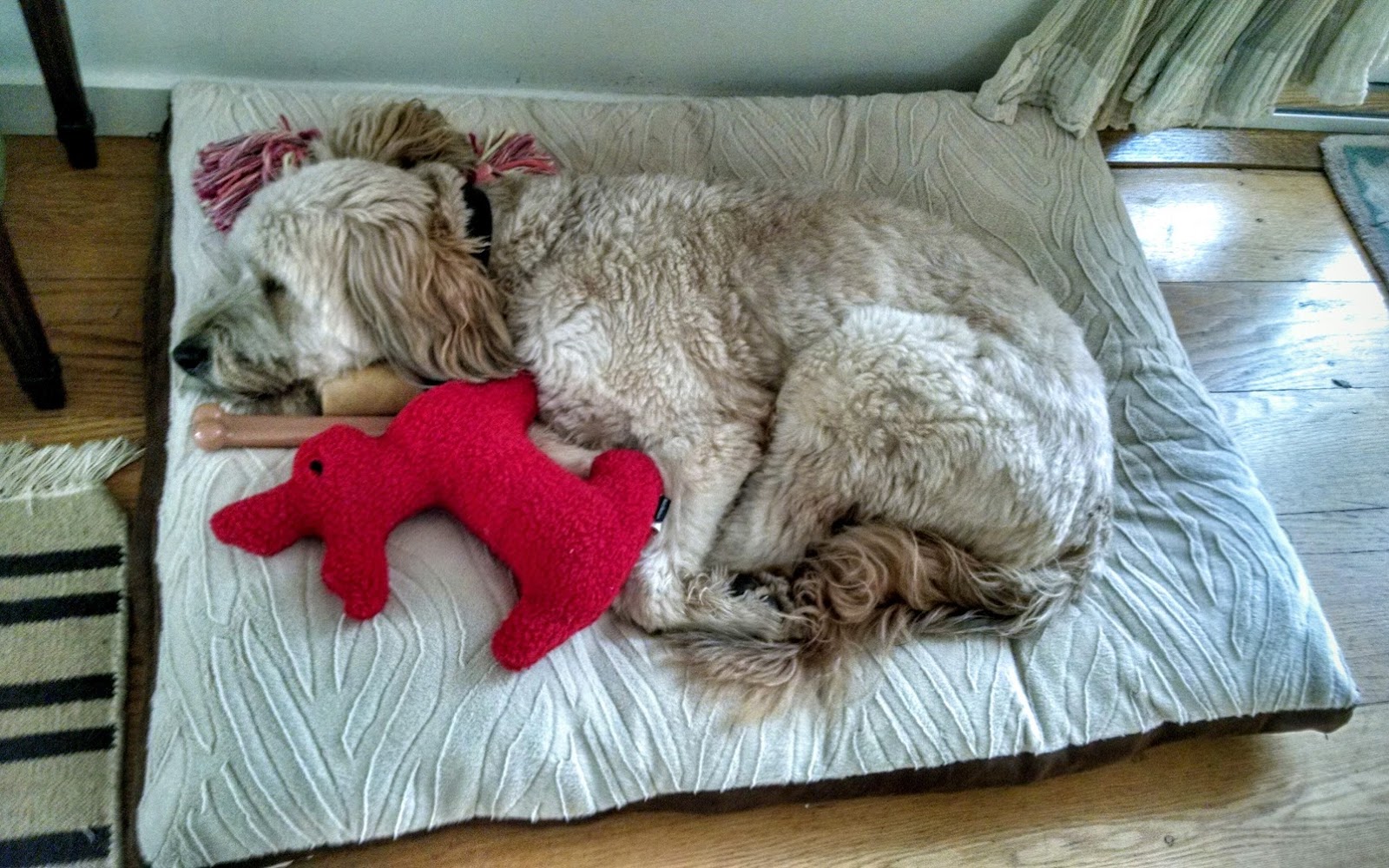
We have a Goldendoodle that we love very much, found abandoned in the streets of New Haven, a total sweetheart.

We were listening to a story on NPR about Trump, whom we do not love. There was an interview with one of his delegates from the midwest – dedicated to the cause. We learned that she and her husband had a truck farm, that she had never been politically active before but was excited to be going to the convention, even though it would cost her thousands of dollars that she did not have. Then in the background there was the sound of barking. She explained that one of her sidelines and great pleasures was raising … Goldendoodle puppies.
Photo from her Facebook page: https://www.facebook.com/rita.gaus
Humans are everywhere, even among Trump supporters. 

Wednesday, July 6, 2016

Company loyalty

The decline of corporate loyalty exemplifies the problem of trust in a fast-moving world. The great companies of the past have struggled to sustain a sense of trust from their employees, while new ones have often built trust and enthusiasm on a new basis.
Most of the great companies of the 20th century built trust through a culture of familial loyalty: employees expected to spend their whole careers with the company, and in return they were expected to identify deeply with it and to be willing to sacrifice for it. But in the competitive pressure-cooker of the 1980s and 90s, most of those companies – notably icons of the old order like IBM, Hewlett-Packard, Procter and Gamble – abandoned that deal. They embraced layoffs, first in crisis, but increasingly as a regular way of doing business, a constant rebalancing.
Now many companies have gone towards the opposite extreme: using material rewards to motivate, giving up on loyalty and trust and a sense of community. That is effectively breaks an old culture, and may make change easier. But it does not make a culture in which people are willing to work together.
Large companies like Google or the “new” IBM, as well as myriad smaller organizations in fields from technology to social enterprise, do something different. They don’t promise stability and security; they promise challenge and growth. Employees are drawn to them for the opportunities to build their skills and their reputations, and perhaps to advance exciting projects and purposes. They don’t particularly expect to keep working there for their entire careers.
That is all very well – in some respects it’s terrific – but it also creates a lot of problems. It’s terrific from the companies’ side because it maximizes their flexibility; it’s also good for employees in that it opens up a world of new choices. While lifetime security at one company has some attractions, it’s incredibly soul-deadening as well. Companies of the past, in exchange for security, demanded conformity, obedience, deference. The new deal allows much more personal agency and encourages more diversity.
But if the new deal at work is good for some people, it is very bad for others – for those who don’t have the skills to make it in the new world; for those who are unfortunate, choose the wrong company at the wrong time, and wind up unemployed; for those with children who need to save reliably for college; for those who don’t like the intense stress of continual uncertainty and challenge.
If business and society want the advantages of flexibility, innovation, responsiveness, they need to pay the costs. They need to help people to replace job security with career security. This certainly involves extensive support for education and training. It almost certainly requires some basic minimum income, or a lifetime Social Security, to carry people through the vicissitudes of uncertain careers. It requires better information to help match people to opportunities, and better regulation of employers who take advantage of the flexibility.
For the moment, most of the costs are borne by the employees, They are the ones who have to figure out how to get through transitions, save in a completely unpredictable environment, build networks of support, find information about possible paths forward. Companies and society, especially in the U.S., bear very little cost for layoffs. There’s growing anger about that unfairness. If trust is to be maintained, and the potential of an advanced economy is to be realized, those burdens will need to be rebalanced.